Changing table
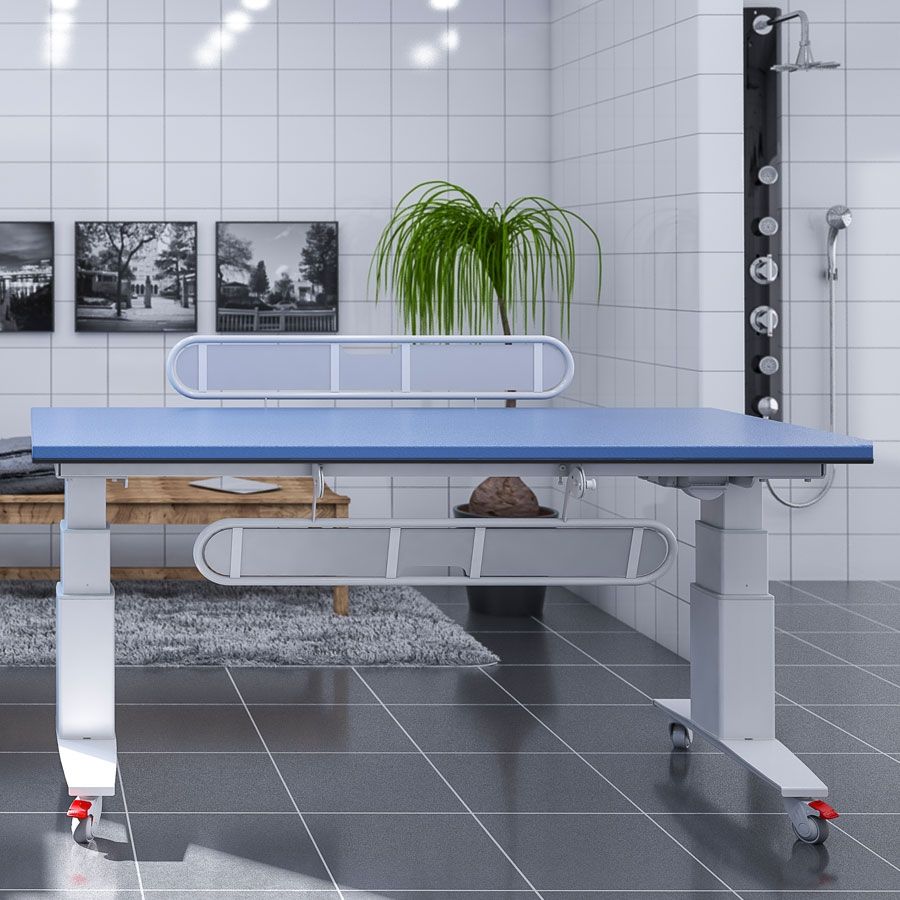
A fixed-position or freestanding workstation for changing and personal care. Height adjustment helps different carers work at a more suitable level, while a surrounding shelf or storage area can keep supplies close to hand.
Accessible living specialists
Trading online since 2010

The names can sound interchangeable, but the equipment is designed around different care routines. Understanding the difference helps you choose the right surface, mobility, capacity and water-management features.
A changing table is primarily a controlled-height surface for changing and personal care. A nursing bench is a larger, mobile care platform designed for higher user weights, hoist access and assisted routines. A shower trolley adds a water-resistant care surface and drainage so showering and wet care can take place on the trolley itself.
Three related products, three different jobs
Changing tables, nursing benches and shower trolleys all bring a person to a workable height for a carer, but their construction and intended use differ. The best starting point is to ask what needs to happen on the surface, how the person will transfer onto it, whether the equipment must move around the room and whether water will be used directly on the platform.
A fixed-position or freestanding workstation for changing and personal care. Height adjustment helps different carers work at a more suitable level, while a surrounding shelf or storage area can keep supplies close to hand.
A larger mobile platform for nursing, changing and assisted care, typically with castors, folding side gates and space below for transfer equipment. Higher-capacity models can support adult care routines.
A mobile height-adjustable platform designed to manage water during showering and washing. A water-resistant surface, raised sides and drainage distinguish it from a conventional nursing bench.
At a glance
The labels matter less than the features behind them. This comparison uses the Granberg Care 343, 345 and 346 ranges currently supplied by Independent 4 Life as practical examples.
Choose by routine
If the main need is changing at a controlled working height, a dedicated changing table can be the simplest solution. Consider surface width, storage, cleaning and the person’s current and future weight.
A mobile nursing bench can provide more space, a substantially higher capacity and clearance beneath the platform for transfer equipment. Side gates and castor brakes then become important parts of the specification.
If water is used directly around the person, specify equipment designed for wet care. Drainage, the shower mattress, hose routing and room falls all need to work as a system.

Real-world examples
The Care 343 is a freestanding Corian changing table offered in five widths, with a powered 750–1150mm working-height range and a 50kg maximum user weight. A separate 343 version incorporates a bathtub for combined changing and bathing.
The Care 345 moves the concept into mobile nursing care, with battery-powered height adjustment, lockable castors, folding gates, hoist clearance and a 200kg capacity. The Care 346 is the wet-care counterpart, adding a shower surface and drainage.
Before you specify
Dimensions and lifting range matter, but so do transfers, staff positions, storage, water, infection-control routines and the route through the room.
FAQs
Not necessarily. Both provide a care surface and may be height-adjustable, but nursing benches are commonly larger, more mobile and designed around assisted care, transfers and higher user weights. Always compare the actual specification rather than relying on the label alone.
Only if the manufacturer has designed and specified it for wet care. A shower trolley is built around water-resistant surfaces and drainage; a conventional nursing bench may not be.
It allows the care surface to be repositioned for different carers and tasks, reducing the need to work continually at one fixed level. It does not replace safe moving-and-handling practice or an individual assessment.
The 345 is a mobile nursing bench for nursing and changing routines. The 346 is a mobile shower trolley designed for wet care, with a shower surface and drainage. Both current ranges include powered height adjustment and 200kg capacity.
The Care 345 is specifically designed with free space beneath for a patient lift or mobile hoist. Hoist compatibility still needs to be checked against the exact hoist base, room layout and transfer plan.
They can be relevant in schools, care homes, healthcare, rehabilitation and domestic assisted-care settings. Suitability depends on the individual, the care routine and the room rather than the building type alone.
Need help choosing?
Tell us who the equipment needs to support, how transfers are managed and whether the task involves dry changing, nursing care or showering. Our team can help you narrow the right type of product before you compare individual models.