Grab rails
A user may pull, push or partially support body weight through the rail. Loads can change direction during standing, turning and transfers.
Browse handrails & support rails →Accessible living specialists
Trading online since 2010

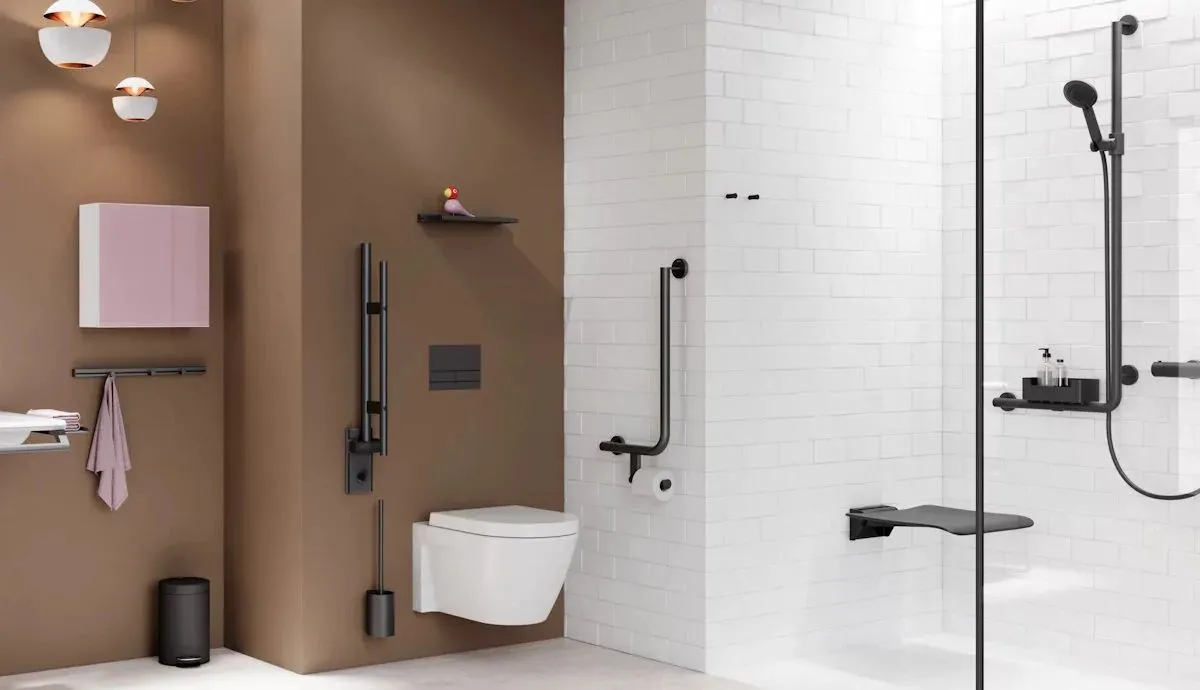
Grab rails, folding support arms, shower seats and adjustable bathroom equipment can carry substantial forces. Their published product capacity is only useful when the fixings and the wall or floor behind them can safely transfer those loads.
Accessible bathroom equipment is often load-bearing equipment, not decoration. The product, brackets, fasteners, substrate and any reinforcement form one load path. A strong grab rail or shower seat can still be unsafe if it is fixed into an unsuitable wall build-up or installed with the wrong fixings.
Think beyond the visible product
When someone pulls on a grab rail or transfers onto a shower seat, the force does not stop at the product. It has to travel through every connection behind it.
Different products create different demands
A user may pull, push or partially support body weight through the rail. Loads can change direction during standing, turning and transfers.
Browse handrails & support rails →A long projecting arm can create leverage at the wall connection, particularly during toilet transfers. The mounting system and wall construction are part of the specification.
A seat carries body weight away from the wall and can experience additional forces as the user sits down, stands up or moves during showering.
Browse shower seats →Powered or assisted basin systems transfer the basin, frame and user interaction back into the supporting structure.
Wall-mounted or floor-mounted care equipment can carry higher loads and repeated dynamic use, so the supporting structure must match the manufacturer’s requirements.
Track-mounted rails and other adjustable systems can spread or relocate loading, but the track itself still needs a suitable structural connection.

Product rating is not wall rating
A manufacturer may state a load capacity for the product when it is installed correctly. That does not mean the same product can be attached to any tiled wall with any generic wall plug.
For example, AKW’s heavy-duty grab-rail instructions state that the fixings must be matched to the rail, surface and loading conditions, and that all fixing holes should be used. This is why the wall build-up needs to be known before installation.
The finish can hide very different structures
Two bathrooms can look identical after tiling while having very different fixing capacity behind the surface.
Brick or blockwork can provide a strong substrate when the fixing type, embedment and product instructions are appropriate.
Accessible products can be planned into framed walls using suitable reinforcement positioned around the intended fixing zones.
Plasterboard or tile backer alone may not provide the structural capacity required for load-bearing supports. The actual system needs to be assessed.
Retrofit work often starts without reliable drawings. Where the structure is uncertain, investigate before relying on assumptions or generic fixings.
Before installation
Position and fixing strength are linked. A beautifully reinforced fixing zone is no help if the support is in the wrong place for the transfer, and the perfect rail position is not safe if the wall cannot carry the load.
Installer checklist
FAQs
The tile is a finish, not usually the structural support. The fixing needs to transfer the load into a suitable substrate behind the finish, using a method appropriate to the product and wall construction.
A lightweight wall may need designed reinforcement or a specialist structural fixing strategy. Do not assume that the plasterboard or tile layer alone can carry a load-bearing support.
A product capacity is generally based on the product being installed correctly under the manufacturer’s stated conditions. It does not turn an unsuitable wall into a suitable one.
They project away from the wall, which can create leverage at the mounting points as a person transfers or pushes down on the arm.
The sequence depends on the product and wall system, but the structural fixing strategy should be planned before finishes hide the substrate. Reinforcement is much easier to provide during construction than after the bathroom is complete.
Use the current installation documentation for the exact product. Many Independent 4 Life product pages include manufacturer PDFs, and our team can help locate technical documents for products we supply.
Fix the support to something that can support it
Check the exact product instructions, actual wall or floor construction and intended user movement before installation. If you need manufacturer documentation for a product we supply, our team can help locate it.