


Ramps & Access
Threshold Ramp vs Portable Ramp vs Modular Ramp: What’s the Difference?
A practical guide to three very different ways of overcoming steps and level changes, and how to decide which type of wheelchair ramp suits the obstacle, available space and everyday use.
01
Quick Answer
A threshold ramp is designed for a relatively localised change in level at a doorway. A portable ramp is deployed when needed and removed or stored afterwards. A modular ramp system is built from longer sections, platforms and optional handrails to form a more substantial everyday access route. The right choice depends on the rise, available run, doorway, mobility equipment and how permanent the route needs to be.
Start with the obstacle
These ramp types solve different access problems
It is tempting to choose a ramp by length alone, but that can lead to the wrong product. A small raised threshold at a front door is fundamentally different from an external entrance that needs several metres of access route, even if both are described simply as a “step”.
| Ramp type | Best suited to | Typical character | Main question |
|---|---|---|---|
| Threshold ramp | Door sills and smaller localised level changes | Compact and obstacle-specific | What exactly does the doorway profile look like? |
| Portable ramp | Steps or obstacles where access is occasional or the ramp cannot stay in place | Deploy, use, remove and store | Can the intended user safely carry, position and store it? |
| Modular ramp | Higher rises or longer-term entrances needing a complete route | Long sections with optional platforms and handrails | How much run, landing space and doorway clearance are available? |
There is also a useful fourth category: relocatable external ramps.
These can provide a stable leave-in-place route without becoming a permanent concrete structure. They sit between portable and full modular systems for some entrances.
01 / Localised level changes
What is a threshold ramp?
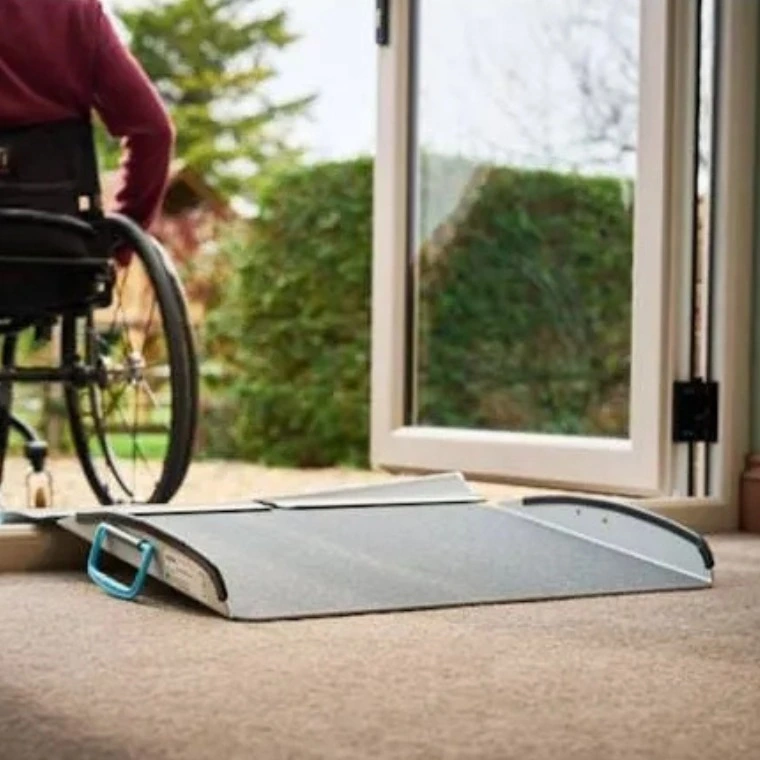
Threshold ramps are designed around smaller changes in level at doorways. They may be simple wedges, low-profile aluminium sections or configurable kits shaped around timber and uPVC thresholds.
The key advantage is proportion. If the barrier is a relatively small sill, installing a long portable or modular entrance ramp may create more bulk than the problem requires.
01
Measure both sides
Some door thresholds rise and fall in different ways. Record the height, shape and clear landing area, not just one vertical number.
02
Check the door
Consider whether the door opens inward or outward and whether the ramp or user will conflict with the door swing.
03
Think about everyday traffic
A doorway may be used by wheelchair users, walkers, pedestrians, pets and people carrying items. The transition should suit the route as a whole.
02 / Access when required
What is a portable ramp?
A portable ramp is intended to be deployed when access is needed and removed afterwards. Full-width versions give the wheelchair or mobility device one continuous surface. Folding and suitcase formats can reduce the stored size, while separate channel ramps divide the system into two narrower tracks.
Independent 4 Life’s current Aerolight range includes full-width non-folding, folding and multi-fold options. The Aerolight-Xtra, for example, folds along its centre to make storage easier, with different lengths carrying different maximum loads.
Full-width ramp
Continuous surface
Wheelchairs, walkers and pedestrians use one broad surface, so wheel alignment is less restrictive than with separate tracks.
- Useful for mixed users
- Folding and non-folding formats
- Often easier to deploy intuitively
Channel ramp
Two separate tracks
Each channel can be lighter and more compact, but the mobility device must be suitable for the track spacing and aligned correctly.
- Smaller individual components
- Useful where storage is limited
- Wheel arrangement matters
Portable does not automatically mean easy for every user to move.
Longer ramps can still be substantial. Check the dead weight, folded dimensions, carrying method and who will actually deploy the ramp in everyday use.
03 / Build the complete route
What is a modular ramp system?
A modular entrance ramp is made from compatible sections that can be combined to create a longer access route. Platforms can deal with doorway geometry, turns or rest areas, while handrails can be added where required.
Independent 4 Life’s Welcome system is a good example. Current configurations use longer ramp sections with optional platforms and handrails and can be dismantled, adapted or relocated rather than being cast permanently in concrete. Selected Welcome ramp kits are offered in lengths from 1200mm to 4800mm, with a published 400kg maximum load.
A
Longer approach
Useful where the rise demands substantially more run than a doorway wedge or short portable board can provide.
B
Platforms
Can help with outward-opening doors, direction changes, manoeuvring and the geometry of a more complex entrance.
C
Optional handrails
Different configurations allow the route to be built around the installation rather than assuming one standard arrangement.
Before you choose
Six things to establish before buying a ramp
01
Vertical rise
Measure from the lower surface to the level the ramp needs to reach.
02
Available run
Record the clear horizontal distance available without blocking doors, paths or manoeuvring space.
03
Doorway geometry
Check sill shape, clear width, door swing and whether a landing or platform is needed.
04
User & equipment
Wheelchair, scooter, rollator, attendant assistance and wheel arrangement can all affect suitability.
05
Frequency
Occasional access can justify portability; daily independent use may point towards a leave-in-place route.
06
Published load
Check the exact rating for the exact ramp length and configuration. Capacity can change across a range.
Ramp geometry is only part of suitability. Always consider the individual user, the mobility equipment, the environment and current installation guidance.
Frequently asked questions
Ramp type FAQs
Is a threshold ramp the same as a portable ramp?
Not necessarily. Some threshold ramps can be moved, but they are designed specifically around a localised doorway or sill. Portable access ramps are generally designed to bridge a step or obstacle when needed and then be removed.
When should I consider a modular ramp?
When the entrance needs a longer everyday route, a higher rise, a platform, handrails or a more configurable leave-in-place solution.
Are channel ramps suitable for every wheelchair?
No. The wheel configuration and track alignment need to be compatible with the channels. Full-width ramps are often more versatile where several mobility devices or walking users share the route.
Does a longer ramp always carry more weight?
No. Maximum load can reduce as some ramp models become longer. Always use the technical data for the exact selected length.
Continue learning