


Accessible Storage
What Is a Wardrobe Lift?
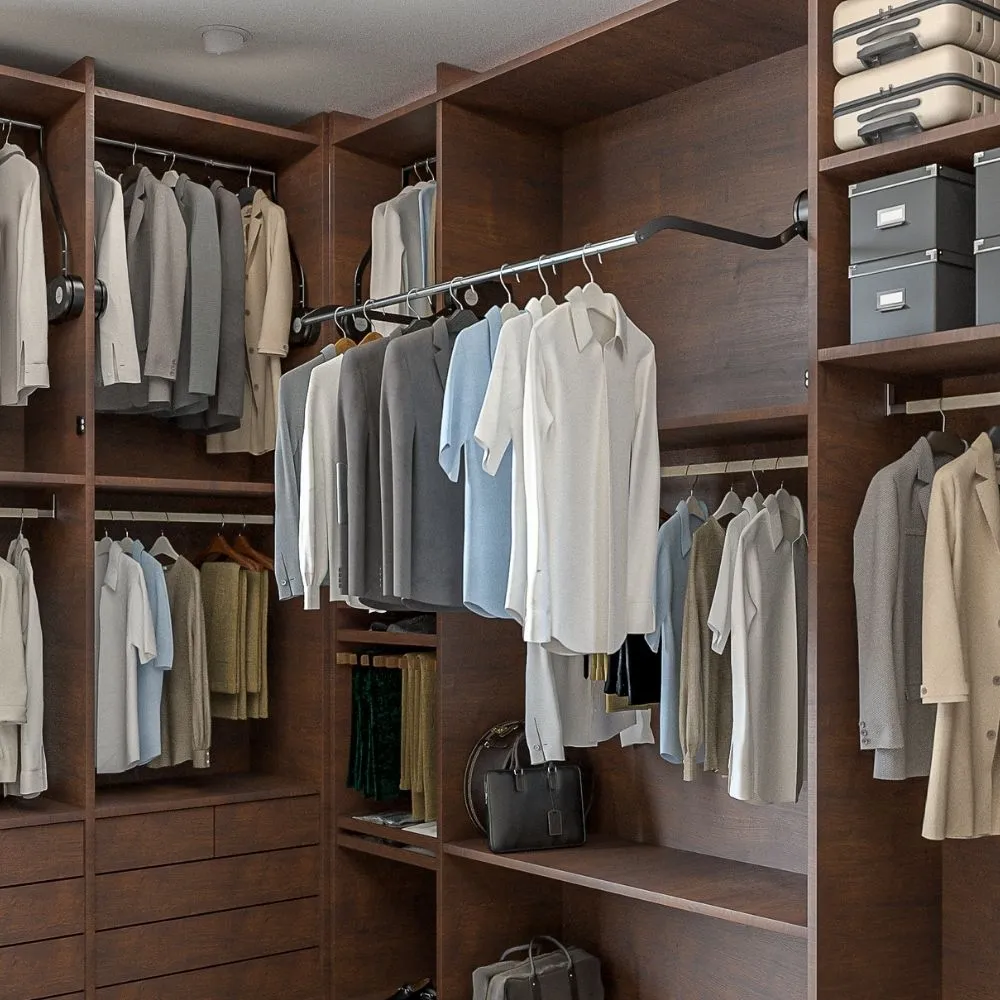
A wardrobe lift brings a high-level clothes rail down towards the user, making hanging storage easier to reach without permanently sacrificing the useful space below.
01
Quick Answer
A wardrobe lift is a mechanism that lowers hanging clothes from a high storage position into a more comfortable reach range. Electric systems move the rail at the touch of a control, while manual pull-down rails are physically lowered by the user. They can help wheelchair users, seated users and people with reduced reach use more of the wardrobe’s vertical space.
The basic idea
Bring the clothes to the user instead of forcing the user to reach up
A conventional wardrobe puts the clothes rail at one fixed height. If that rail is above a comfortable reach zone, a large proportion of the wardrobe can become difficult or impossible to use independently.
A lowering clothes rail changes the storage strategy. Clothing can remain stored higher when it is not needed, then move forwards and down towards the user. That can be particularly useful in a shared bedroom, where accessible storage does not have to mean fixing every rail permanently at a low level.
01
Store high
Use more of the available wardrobe height for hanging clothes.
02
Access low
Move the rail to a more comfortable seated or standing reach position when needed.
03
Keep space below
Drawers, baskets, shelves, footwear or another rail can use the lower part of the wardrobe.
Choose who provides the movement
Electric vs manual wardrobe lifts
Electric
Powered movement
An electric wardrobe lift moves the rail using motors, so the user does not have to physically pull a loaded rail down and push it back up.
- Lower effort
- Repeatable movement
- Useful where grip, shoulder movement or strength is limited
- Requires a suitable electrical supply and clear movement zone
Manual
User-powered movement
A manual pull-down rail uses an operating handle and spring assistance to lower the clothes. It is mechanically simpler and does not require electrical power.
- Lower system complexity
- Useful where the user can comfortably pull and return the rail
- Can retrofit into compatible wardrobes
- Grip, reach and upper-body effort still matter
Manual is not automatically more accessible.
The important question is whether the intended user can safely reach, pull, control and return the loaded rail. Where that effort is a barrier, powered movement can provide a much more independent solution.
Current electric example
Granberg BUTLER 730 and 732
The current Granberg BUTLER range sold by Independent 4 Life uses powered telescopic clothes rails. Both current systems are designed for wardrobe widths from 600mm to 1600mm and have a published maximum clothes-rail load of 30kg.
| Model | What it is designed for | Approximate movement | Why choose it |
|---|---|---|---|
| BUTLER 730 | Conventional upper wardrobe heights | About 704mm down and 591mm out | Brings a normal high clothes rail down to a comfortable working position. |
| BUTLER 732 | Much higher storage positions | About 1118mm down and 762mm out | Uses otherwise difficult high-level wardrobe space while leaving more storage available below. |
Current BUTLER systems use stepless electric movement, a Bluetooth control button and an integrated safety stop that halts downward movement if the mechanism meets an obstruction.
Before installation
Six things to establish before choosing a wardrobe lift
01
User reach
Work out the rail height that feels comfortable when fully lowered.
02
Internal wardrobe width
Measure the usable internal dimension, not only the nominal external cabinet width.
03
Required travel
Standard-height storage and genuinely high-level storage need different movement ranges.
04
Movement path
Doors, shelves, drawers, lighting and neighbouring storage must not obstruct the complete arc.
05
Cabinet structure
The wardrobe sides and fixings need to support the mechanism and moving load.
06
Controls & power
Position electric controls within reach and plan the electrical supply before the wardrobe is finished.
Who benefits?
Wardrobe lifts are about reach, not labels
A lowering clothes rail can be useful whenever high-level hanging storage is beyond a comfortable reach. That may include wheelchair users, people who dress while seated, people with restricted shoulder movement, older users or simply a shared household where people have very different reach ranges.
Accessible storage can still look like ordinary fitted furniture.
The mechanism sits within the wardrobe. The room does not need to be designed around an obviously clinical piece of equipment.
Frequently asked questions
Wardrobe lift FAQs
Can a wardrobe lift be added to an existing wardrobe?
Sometimes. Suitability depends on the internal dimensions, structure, fixing arrangement and clear movement path. A compatible existing wardrobe can often accept a manual or electric system, but it should be checked before ordering.
Do electric wardrobe lifts need a remote control?
Not necessarily. Current Granberg BUTLER systems include a Bluetooth local control button, with optional handheld controls available.
How much clothing can a BUTLER lift carry?
The current BUTLER 730 and 732 ranges have a published maximum clothes-rail load of 30kg. Always use the current technical data for the exact model.
Can I see a wardrobe lift working?
Yes. Independent 4 Life’s Petersfield showroom includes powered Granberg wardrobe lifts, and the display can also be explored online.
Continue learning