


What Does It Mean to Be "Wheelchair-Friendly"?
Accessibility School
What does "wheelchair-friendly" actually mean?
If you're looking for general wheelchair-friendly products, rather than advice and support, try narrowing down your search into one of the categories at the top.
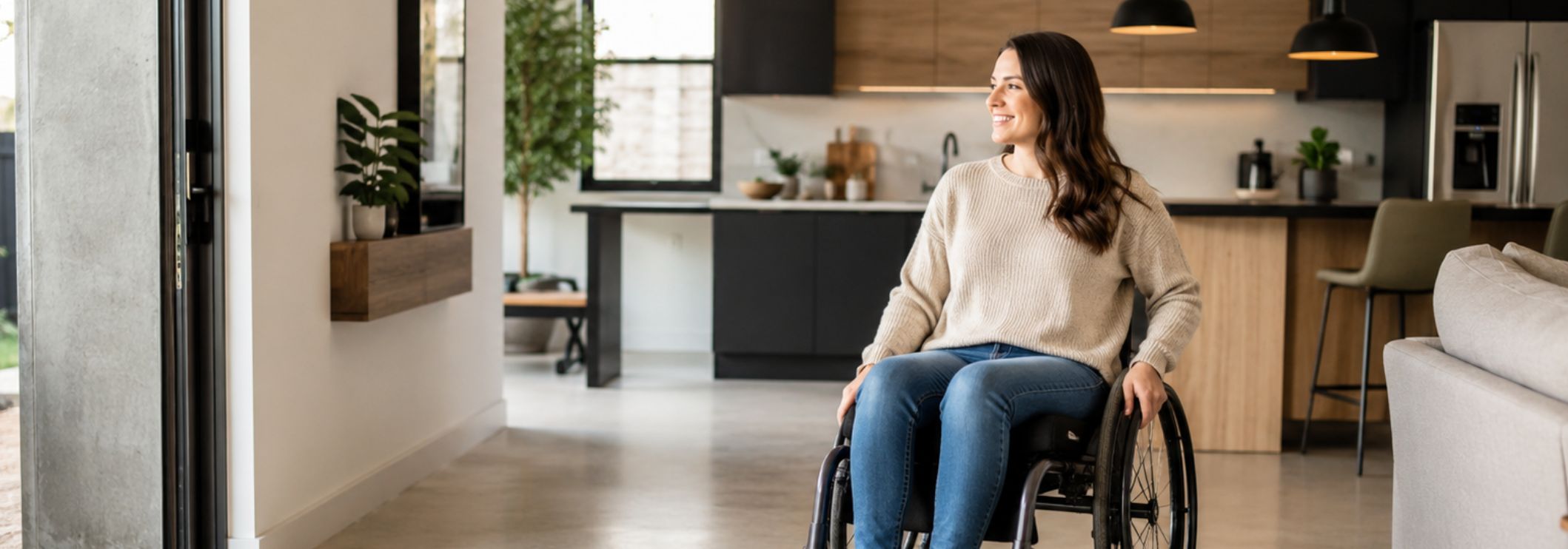
A wheelchair-friendly space is one that allows a wheelchair user to move through, access, and use an environment safely, comfortably, and independently.
However, the term is often used very loosely.
A property may be advertised as:
- wheelchair-friendly
- wheelchair accessible
- accessible
Yet in practice, it may still present significant barriers.
Summary
Being wheelchair-friendly means more than simply removing steps. It involves movement space, access, reach, usability, and the ability to carry out everyday activities independently.
A truly wheelchair-friendly space is designed around how people use it — not just how they enter it.
Why This Matters
One of the biggest challenges in accessibility is that terms like:
- wheelchair-friendly
- accessible
- disabled-friendly
Are often used interchangeably.
The problem is:
These terms do not always mean the same thing.
Example
A restaurant may describe itself as wheelchair-friendly because it has a ramped entrance.
But what if:
- the toilet isn't accessible?
- tables can't be approached?
- circulation space is limited?
Is it really wheelchair-friendly?
Most wheelchair users would probably say no.
Wheelchair-Friendly vs Wheelchair Accessible
Direct Answer
Wheelchair-friendly generally suggests a space is easier to use for wheelchair users, while wheelchair-accessible usually implies a higher level of accessibility has been considered.
In practice, the distinction is often unclear.
This is why it is important to look beyond the label and assess how the space actually works.
What Makes a Space Wheelchair-Friendly?
Direct Answer
A genuinely wheelchair-friendly environment usually considers:
- access
- movement
- reach
- usability
- independence
Let's look at each of these.
1. Step-Free Access
This is usually the first thing people think about.
Examples include:
- level entrances
- ramps
- flush thresholds
Why it matters
If a wheelchair user cannot enter the space independently:
Nothing else matters.
However:
Step-free access alone does not create accessibility.
2. Movement Space
Once inside, users need enough room to:
- manoeuvre
- reposition
- turn comfortably
Common considerations include:
- corridor widths
- circulation routes
- turning space
Many guidance documents reference a:
1500mm wheelchair turning circle as a useful benchmark.
3. Reach and Interaction
A wheelchair-friendly space should allow people to:
- reach controls
- access storage
- use fixtures independently
Examples include:
- light switches
- sockets
- shelving
- taps
- appliances
If items cannot be reached comfortably:
The space may not function properly.
4. Accessible Kitchens
A kitchen is often one of the most challenging spaces in a home.
A wheelchair-friendly kitchen should consider:
- movement space
- worktop access
- storage usability
- appliance positioning
Modern solutions may include:
- height-adjustable worktops
- accessible storage
- adaptable layouts
5. Accessible Bathrooms
Bathrooms require particular attention because they combine:
- movement
- water
- safety
A wheelchair-friendly bathroom may include:
- level access showers
- appropriate circulation space
- accessible fixtures
- safe transfer areas
Independence Is the Real Measure
Direct Answer
The best way to assess whether a space is wheelchair-friendly is to ask whether it can be used independently.
Can someone:
- enter?
- move around?
- reach what they need?
- complete everyday tasks?
Without assistance.
If the answer is yes:
The space is likely performing well.
Common Examples of "Wheelchair-Friendly" Features
Residential Properties
- level entrances
- wider doorways
- accessible kitchens
- accessible bathrooms
Workplaces →
- accessible entrances
- lift access
- adaptable workstations
- accessible toilets
Hospitality Settings
- accessible bedrooms
- accessible bathrooms
- step-free circulation
- suitable dining spaces
Common Mistakes When Designing Wheelchair-Friendly Spaces
1. Focusing Only on Entry
Getting into a space is only the first step. Using it is what matters.
2. Ignoring Turning Space
Movement is often the biggest challenge.
3. Forgetting Reach Range
Features that cannot be reached cannot be used.
4. Treating Accessibility as an Add-On
Accessibility works best when integrated from the beginning.
Wheelchair-Friendly and UK Guidance
Direct Answer
Many principles of wheelchair-friendly design are supported by guidance such as:
- Part M →
- BS 8300
- inclusive design standards
These documents address:
- movement
- circulation
- access
- usability
Why Wheelchair-Friendly Design Benefits Everyone
One of the biggest misconceptions is that wheelchair-friendly design only benefits wheelchair users.
In reality, features such as:
- step-free access
- better layouts
- improved circulation
- adaptable spaces
Often benefit:
- parents with pushchairs
- people carrying shopping
- older adults
- people recovering from injury
Good accessibility often improves usability for everyone.
Common Misconceptions About Wheelchair-Friendly Design
"A ramp makes a building wheelchair-friendly."
A ramp may improve access, but accessibility involves much more.
"Wheelchair-friendly means clinical."
Modern accessible design can be contemporary, stylish, and integrated.
"It requires huge amounts of space."
Good design is often more important than room size.
"It only applies to wheelchair users."
Many accessibility improvements benefit a wide range of people.
Frequently Asked Questions (FAQ)
What does wheelchair-friendly mean?
A space that can be safely and independently used by wheelchair users.
Is wheelchair-friendly the same as wheelchair-accessible?
Not always. The terms are often used differently depending on context.
What is the most important feature?
Usability and independence.
Does wheelchair-friendly design require large spaces?
Not necessarily. Good layouts are often more important.
Can an existing home become wheelchair-friendly?
In many cases, yes, through thoughtful adaptation and design.
Final Thoughts: It's About Independence, Not Labels
The term "wheelchair-friendly" is useful.
But what really matters is how a space performs.
A truly wheelchair-friendly environment allows people to:
- move confidently
- use facilities independently
- participate fully in everyday life
The best wheelchair-friendly spaces don't simply allow access — they enable independence.
Your Next Step
If you're planning an accessible home, workplace, or hospitality project, focus on usability rather than labels.
→ Explore accessible kitchen systems → View adapted bathroom solutions → Speak to our team about creating wheelchair-friendly spaces
A space isn't wheelchair-friendly because it's described that way. It's wheelchair-friendly because it genuinely works for the people who use it.