

Accessible Kitchens
How Do You Choose an Accessible Kitchen Tap?
The best accessible tap is not simply one with a longer handle. Reach, grip, operating force, spout position, sink layout, water pressure and the way the worktop moves all affect how easy it is to use.
01
Quick Answer
Choose an accessible kitchen tap by checking how the user will reach and operate it, not just how it looks. A long or open lever can reduce the need for a tight grip, while the tap’s height, projection and mounting position determine whether it can be reached comfortably from a seated position. Also check water pressure, WRAS status where relevant, hose length and compatibility with a height-adjustable worktop or sink.
Start with the hand movement
Can the user operate the control comfortably?
Traditional tap handles can demand pinch grip, finger strength or a twisting action. For somebody with reduced dexterity, arthritis, limited grip or one-handed use, that can turn a simple kitchen task into repeated effort.
01
Long lever
A longer handle increases the operating surface and can allow the tap to be moved with a hand, fist, wrist or forearm rather than fingertips alone.
02
Open lever
An open-loop handle can be easier to catch and move where grip strength is limited.
03
Single lever
One control can make flow and temperature easier to understand and adjust than separate hot and cold handles.
“Accessible” should describe how the tap is actually operated.
A product can look suitable but still be difficult if the handle is too short, the movement is stiff or the control is mounted beyond the user’s comfortable reach.
Reach before appearance
Where will the tap sit relative to the user?
The same tap can feel easy or difficult depending on where it is installed. A tall tap mounted far behind a deep sink may still be hard to reach from a wheelchair even if the handle itself is excellent.
Consider the user’s approach, the depth of the sink bowl, whether knee space is provided below, and whether the control should sit to the side or closer to the front of the worktop.
A
Handle reach
Can the user reach the control without leaning dangerously forward?
B
Water reach
Is the outlet positioned where hands, pans and washing tasks can be reached comfortably?
C
Shared use
Will seated and standing users both be able to operate the tap without creating a compromise for either?
Geometry matters
Check spout height, projection and swivel
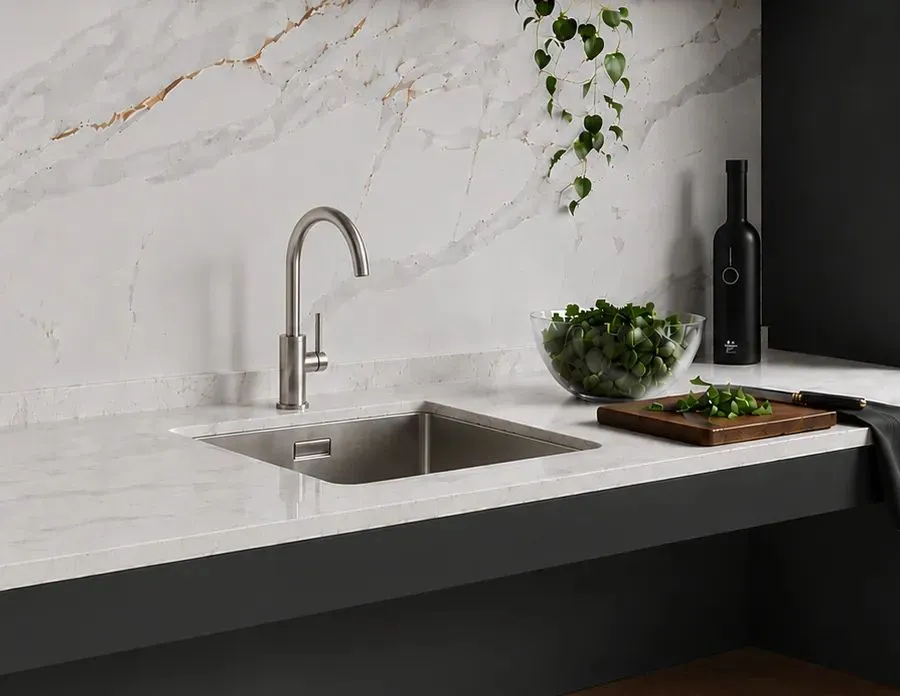
Spout design affects much more than appearance. A high neck can provide clearance for large items, while a lower or more forward outlet can be easier to reach from a seated position. Swivel control also matters if the sink has multiple bowls or if the spout must stay within a safe area.
| Feature | Why it matters | What to check |
|---|---|---|
| Projection | Determines how far the outlet reaches into the sink. | Does the water land in a comfortable working zone? |
| Spout height | Affects clearance and how high the user needs to reach. | Balance accessibility with the pots and tasks the kitchen needs to support. |
| Swivel range | Useful for multi-bowl sinks and flexible working positions. | Can rotation be limited where required to avoid water outside the sink? |
| Lever length | Changes the amount of reach and grip needed. | Can the intended user operate it using their strongest comfortable movement? |
Technical checks
Water pressure and WRAS approval still matter
Accessibility does not replace normal plumbing requirements. Check the manufacturer’s minimum and maximum operating pressure and make sure the tap is appropriate for the water system serving the property.
WRAS approval can also be important when selecting products connected to the UK water supply. For example, the Häfele accessible long-lever mixer sold by Independent 4 Life uses a WRAS-approved ceramic cartridge, while Granberg’s Ergo KM11 is designed specifically around accessible and height-adjustable kitchen installations.
Height-adjustable kitchens
If the worktop moves, the services must move safely too
A tap installed in a height-adjustable sink worktop needs sufficient flexible connection length and a service arrangement that can move throughout the full travel of the lift without snagging, stretching or being crushed.
Granberg’s Ergo KM11, for example, is supplied with extra-long flexible connections specifically to suit fixed and height-adjustable accessible kitchen installations. The exact hose routing, waste arrangement and movement zone should still be planned around the selected lifting system.
Test the full movement, not just the lowest and highest positions.
Flexible hoses and cables need a controlled path throughout the complete stroke of a moving worktop. A connection that looks fine at one height can still snag midway through travel.
Examples from the current range
Two different ways to improve tap accessibility
Long-lever mixer
Häfele accessible monobloc mixer
This current tap uses an extended ergonomic lever designed to be operated with a clenched fist, wrist or forearm. It has a high-neck monobloc spout and a WRAS-approved ceramic cartridge.
Accessible system tap
Granberg Ergo KM11
The KM11 uses a 165mm extended lever, a lower U-shaped swivel spout and a front-mounted dishwasher shut-off. It is designed around accessible and height-adjustable kitchen systems.
Frequently asked questions
Accessible kitchen tap FAQs
What makes a kitchen tap accessible?
Usually a combination of easy operation, comfortable reach, appropriate spout geometry and installation position. There is no single handle shape that works for every user.
Are long-lever taps only for wheelchair users?
No. They can also help people with arthritis, reduced grip, limited finger dexterity, one-handed use or temporary injury.
Can a normal tap be used on a height-adjustable worktop?
Potentially, but the connections and installation must be able to move safely with the worktop. Taps and hoses designed for moving accessible systems can simplify this part of the specification.
Does WRAS approval make a tap accessible?
No. WRAS relates to water regulations and water-supply suitability, not how easy the tap is to reach or operate. Both technical compliance and usability need to be considered.
Continue learning